The Gift of the Church: Volume 1 - How the Catholic Church Transformed the History and Soul of the West by Ryan N. S. Topping
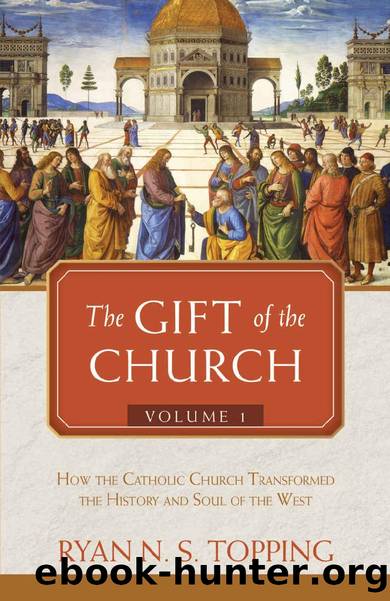
Author:Ryan N. S. Topping [Topping, Ryan N. S.]
Language: eng
Format: epub
Publisher: TAN Books
Published: 2018-08-23T05:00:00+00:00
If the first gift of the Crusades was political and economic, the second was moral and imaginative. Beyond defending the freedom of the West, the popesâ encouragement of the Crusades taught active men how to channel their energy into noble forms of service.
War demands sacrifice. That demand could be elevated to the level of grace. The era from the eleventh through the thirteenth centuries marked the height of chivalry. The knight was taught that his first duty was to protect the weak and to apply his force within the bounds of justice. It is from this era that the popular legends of the Knights of the Round Table emerge. Thomas Aquinas, drawing on Augustine, expressed conditions that had to be met for war to be justified: only the public authority can declare war, it must be engaged for just reasons, waging war must promise reasonable prospect of success, and so on.13 But Thomas, in one way, is merely the beginning of a more complete development of the just war tradition. The whole pursuit of war, in the developing Christian imagination, came to be understood in judicial terms. Concepts like the discriminate and proportionate use of force became finely tuned instruments in other hands. The Spanish theologian Francesco di Vitoria (1485â1546), one of the fathers of international law, articulated this position when he argued: âThe victor must think of himself as a judge sitting in judgment between two commonwealths, one the injured party and the other the offender; he must not pass sentence as the prosecutor, but as a judge. He must give satisfaction to the injured, but as far as possible without causing the utter ruination of the guilty commonwealth.â14
Not even the experience of war can suspend the obligations of the Gospel. War must only be pursued in the cause of justice. Some Christians today would undoubtedly prefer to return to the pacific stand of the early Church, when Christian involvement in the pagan army was generally discouraged; but that would be tantamount to saying that Christ has no wisdom to offer Caesar. It would, in short, be simply to allow war-making to return to where Enlightenment secular theorists and rulers dragged her in the nineteenth and twentieth centuries, and to the Machiavellian wisdom of Carl von Clausewitz who, in his influential textbook on military strategy, On War, declared: âWar is only a continuation of state policy by other means.â15
On the ethics of war, the Church in the twenty-first century continues to offer advice to Caesar. Western militaries to this day issue to their troops ROEs (Rules of Engagement) that legally define, and often radically curtail, the sorts of violence that may be used against enemies. Western multinational covenants, like the Hague Conventions (1899, 1907) and now the Geneva Convention (1949), bind Western soldiers and commanders to disciplinesâsuch as the avoidance of targeting civiliansâthat were unheard of in ancient Greece and find little support among non-Western nations. The roots of these sentiments go back to this late medieval and early modern tradition.
Download
This site does not store any files on its server. We only index and link to content provided by other sites. Please contact the content providers to delete copyright contents if any and email us, we'll remove relevant links or contents immediately.
Professional Troublemaker by Luvvie Ajayi Jones(29762)
Empire of the Sikhs by Patwant Singh(23205)
Twilight of the Idols With the Antichrist and Ecce Homo by Friedrich Nietzsche(18782)
Plagued by Fire by Paul Hendrickson(17540)
The Sun and Her Flowers by Rupi Kaur(14633)
Norse Mythology by Gaiman Neil(13568)
Fangirl by Rainbow Rowell(9473)
A Journey Through Charms and Defence Against the Dark Arts (Harry Potter: A Journey Throughâ¦) by Pottermore Publishing(9340)
Adultolescence by Gabbie Hanna(9022)
Wonder by R.J. Palacio(8724)
Tools of Titans by Timothy Ferriss(8594)
Becoming Supernatural by Dr. Joe Dispenza(8375)
How to Bang a Billionaire by Alexis Hall(8275)
Wonder by R. J. Palacio(8244)
Crystal Healing for Women by Mariah K. Lyons(8009)
The Road Less Traveled by M. Scott Peck(7731)
The Lost Art of Listening by Michael P. Nichols(7622)
The Witchcraft of Salem Village by Shirley Jackson(7434)
The Institute by Stephen King(7153)
